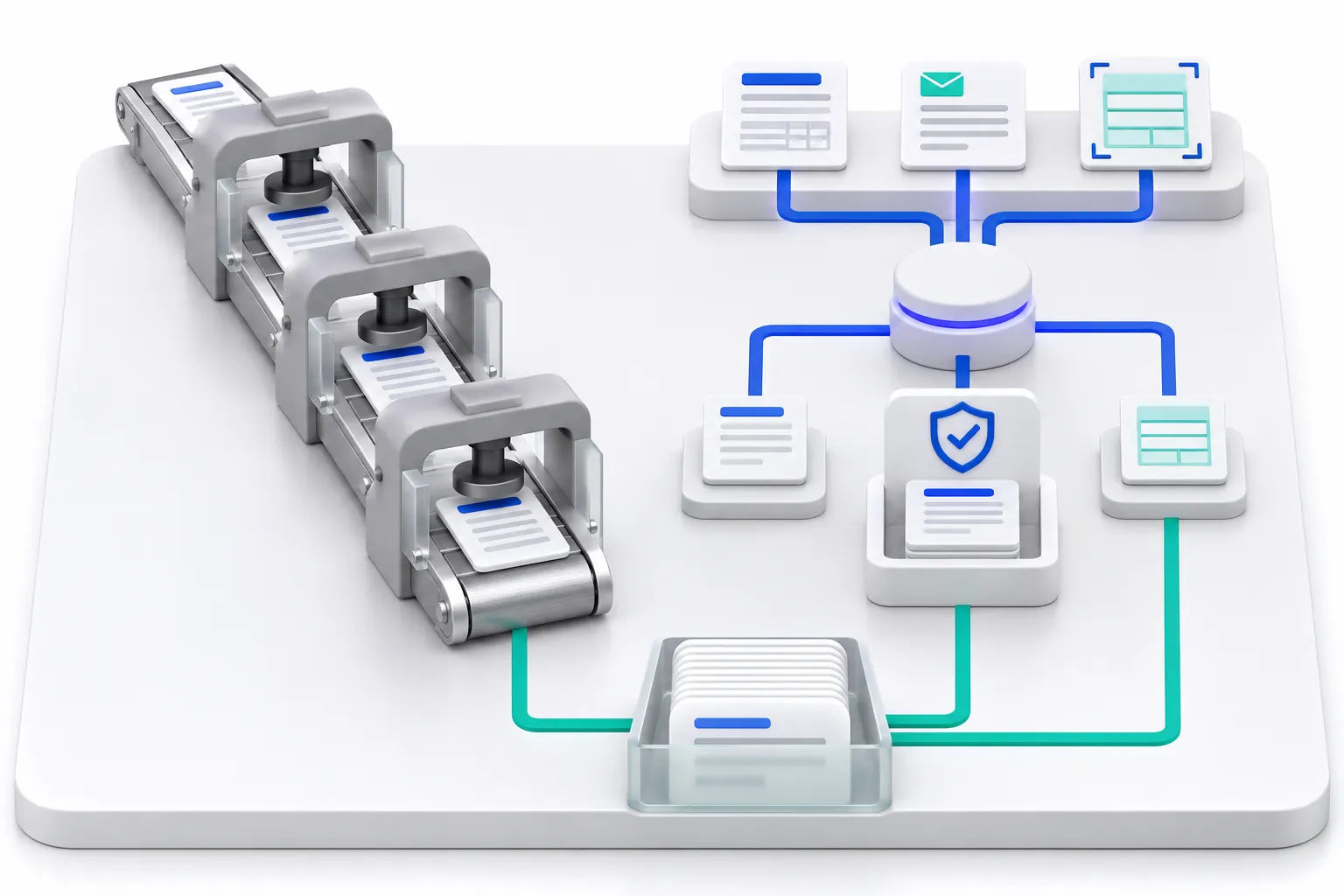
Consider a spare parts distributor that receives purchase orders in three ways: through a customer portal, as structured files from larger customers, and as emails carrying PDFs, scans and the occasional photo of a handwritten list. A software bot already keys the portal orders into the ERP without trouble. The emailed orders are another matter. Part numbers are abbreviated, quantities sit in free text and some customers ask for a substitute if an item is out of stock. Nobody can write a rule for every variation. That is the line between robotic process automation (RPA) and agentic AI, and most businesses need to decide, step by step, which side of it each piece of work sits on.
Use a bot when the path is known, an agent when the path depends on what arrives, and a person when the decision carries weight.
To apply this workflow in your business, explore our agentic automation service and implementation approach.
What is RPA, and what is it good at?
Robotic process automation (RPA) uses software bots to repeat a defined sequence of steps, usually through the same screens a person would use: open an application, copy a value, fill a field, press a button, save a file. Microsoft's documentation for Power Automate desktop flows, for example, describes automating repetitive, rule-based desktop tasks across modern and legacy applications, with the bot working through interface elements, images or screen coordinates.
That design gives RPA its strengths. A bot does the same thing every time, so the result is predictable and easy to audit. Once built, it is inexpensive to run at volume, and it can work with older systems that offer no other way in. For stable, structured work, such as copying confirmed portal orders into the ERP or downloading the same set of reports each morning, it remains a sensible choice.
The weaknesses come from the same source. A bot only knows the path it was given. If a screen layout changes, a field moves or an input arrives in an unexpected format, it stops or, worse, carries on with the wrong value. Every new variation becomes another rule to write, test and maintain.
References: Microsoft Learn: introduction to desktop flows in Power Automate
What is agentic AI, and how is it different from an RPA bot?
Agentic AI uses a large language model to decide how to complete a task within limits you define: which information to look up, which tool or system to use, in what order, and when to stop or ask a person. Anthropic's engineering guidance draws a useful distinction between workflows, where models and tools follow predefined code paths, and agents, where the model dynamically directs its own process and tool use.
That flexibility is what makes agents useful for messy inputs. A model can read an email written in plain language, recognise that two differently written part descriptions refer to the same item, and work out what information is missing before anything is entered. The same guidance is candid about the trade-off: agentic systems often trade latency and cost for better task performance, and autonomy brings the potential for compounding errors.
In practice, agentic is a spectrum rather than a single product. At one end, a model extracts fields from a document inside a fixed workflow. At the other, an agent plans and carries out several steps on its own. Start with the simplest level that does the job, and add autonomy only where the process genuinely needs it.
References: Anthropic: Building effective agents
Agentic AI vs RPA: which should you use for each step?
Few processes are purely rules-based or purely a matter of judgement, so the useful question is what each step needs. The table is a practical decision aid rather than a product comparison, since many automation platforms now offer both capabilities.
| If the step looks like this | Start with | Why |
|---|---|---|
| Structured input, stable screens and one correct result | RPA or a direct integration | Rules give the same answer every time at a low cost per run |
| A system with a supported interface (API) | Direct integration | More reliable than automating screens and easier to monitor |
| Emails, PDFs or free text that vary by sender | AI extraction checked by validation rules | The model reads the variation; rules confirm the result against master data |
| Exceptions that need context from several systems | An AI agent that proposes, with a person or rule that decides | The agent gathers the evidence so the reviewer can decide quickly |
| Calculations, tolerances and approval limits | Rules in code or ERP configuration | These are business decisions that must be exact, visible and owned |
| Payments, refunds, master data or customer commitments | Human approval every time | High-impact actions need a named approver and an audit trail |
| A rare task with unclear rules | Leave it manual for now | Automation costs more than it saves until the pattern is clear |
When does RPA still beat agentic AI?
Rules-based automation is the better choice when the input is structured, the screens or files are stable and there is one correct result. Moving a nightly stock file from a warehouse system into the ERP, producing the same weekly report or posting confirmed goods receipts are steps where a language model adds cost and uncertainty without adding value.
Rules should also own any decision that must be exact and explainable by policy. Price calculations, matching tolerances, discount thresholds and approval limits are business decisions. They belong in code or ERP configuration, where they are visible, owned and identical every time, not in a model's judgement.
Finally, check whether the system offers a supported interface. A direct integration through an API is usually more reliable and easier to monitor than either a bot clicking through screens or an agent operating a user interface. Treat screen automation as the fallback for systems that offer no other route.
Where does agentic AI handle what RPA cannot?
Agents earn their place where inputs vary. Purchase orders sent as emails and PDFs, supplier delivery notes, customer queries and quality complaints rarely follow one format. A model can extract the relevant details, map them to your item and customer records, and flag anything it could not match with confidence.
They are also useful for exceptions: the cases that fall outside the rules and currently wait in someone's inbox. An agent can gather the context a person would collect, such as the order history, the stock position, the price agreement and previous correspondence, then propose a resolution with the evidence attached. The reviewer starts from a prepared case instead of a blank search.
Agents are less suited to steps that need an exact, repeatable answer. Let the agent interpret and propose, and let rules and systems calculate, validate and record.
How do agentic AI and RPA work together in one process?
A reliable pattern is AI at the edges and rules in the middle. The agent turns unstructured input into a structured proposal. Validation rules check that proposal against master data, prices and stock. Existing bots or integrations carry out the fixed steps, and anything that fails validation goes back to the agent for more context or to a person for a decision.
Applied to the spare parts example, the agent reads an emailed order, identifies the customer, the part numbers and the quantities, and marks any uncertain match. Rules confirm the prices against the customer's agreement and check stock. If everything passes, the existing bot or interface creates the sales order in the ERP. If the customer asked for a substitute, the agent prepares a proposal for the sales team rather than choosing one itself.
This approach protects the investment in bots that already work and removes the manual triage that sat in front of them. It also gives each part of the process a clear owner: the model for interpretation, the rules for policy and people for judgement.
Which permissions and approvals should an AI agent have?
The OWASP Top 10 for LLM Applications 2025 lists excessive agency as a risk: an AI system taking damaging actions in response to unexpected, ambiguous or manipulated model output. OWASP traces it to three causes: excessive functionality, excessive permissions and excessive autonomy.
The practical controls follow directly. Give the agent only the tools the task needs, with the narrowest permissions that work, such as read-only access to records it only needs to look up. Enforce authorisation in the systems it calls rather than in the prompt, because an instruction to a model is not a security control. Log every tool call with its inputs and result.
Separate proposing an action from executing it. Require a named person to approve anything that is hard to reverse or affects a customer, a payment or master data, such as issuing a refund, confirming a substitute part or changing a delivery address. Set stopping conditions, such as a maximum number of steps, so an agent that is stuck hands the case to a person instead of trying indefinitely.
References: OWASP Top 10 for LLM Applications 2025: LLM06 Excessive Agency
Questions readers ask
Is agentic AI replacing RPA?
Not in most businesses. Rules-based bots remain the cheaper and more predictable choice for stable, structured, high-volume steps. Agentic AI is better suited to the unstructured inputs and exceptions that bots cannot handle, so the two are increasingly used together in the same process.
Can an AI agent use existing RPA bots?
Yes, if each bot is exposed as a tool with clear inputs, outputs and permissions. The agent prepares a validated request and the bot carries out the fixed steps. Treat every bot the agent can call as a permissioned action, with human approval where the result is hard to reverse.
Is agentic AI less reliable than RPA?
It is less predictable, not necessarily less useful. A bot gives identical results for identical inputs but fails on anything unexpected. An agent handles variation but can make mistakes, so it needs validation rules, test cases, limited permissions and human review for high-impact steps.
Which process should a business automate first with an AI agent?
Choose a process with a clear owner, a steady volume of unstructured inputs or exceptions, and a result a person can check quickly, such as emailed purchase orders or supplier delivery queries. Start with the agent proposing and people approving, then widen its scope as evidence builds.
A practical starting checklist
- Each process step classified as rules, AI or manual
- Direct integrations preferred over screen automation
- Least-privilege tools and permissions for every agent
- Human approval for actions that are hard to reverse
Choose automation step by step: rules where the answer is fixed, AI where the input varies and people where the decision carries weight. Combined that way, bots and agents strengthen each other instead of competing.
Original guide by the IOT Software and Solutions editorial team. External facts are linked to their sources; examples are illustrative and do not describe measured client results.