
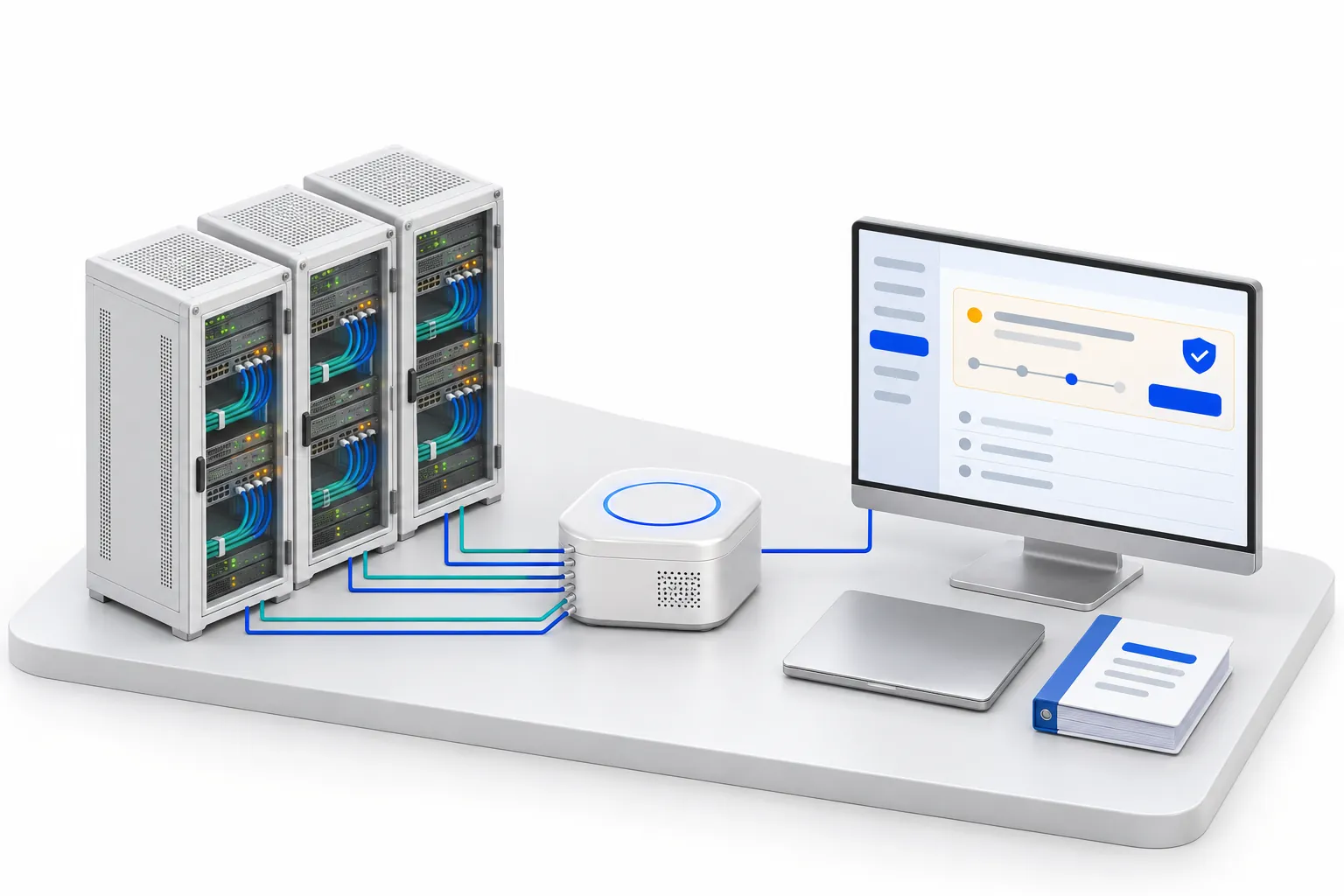
Picture a night on call. A storage array starts responding slowly, and within ten minutes the engineer has received dozens of alerts: database latency, application timeouts, failed health checks, a growing message queue and a disk warning, each from a different tool. They all describe one problem, but working that out takes most of the first half hour. AIOps (artificial intelligence for IT operations) is aimed squarely at this moment: turning many signals into one incident, showing where the trouble probably started and helping the team act quickly without losing control. This guide explains what AIOps does, where it helps and how to measure it.
Fewer, better alerts and faster evidence matter more than automatic fixes.
To apply this workflow in your business, explore our AI for infrastructure service and implementation approach.
What is AIOps?
AIOps, short for artificial intelligence for IT operations, applies machine learning and, increasingly, language models to the data that IT systems produce, so teams can detect, understand and resolve problems faster. A 2020 systematic mapping study of AIOps research by Notaro, Cardoso and Gerndt describes it as an approach proposed to tackle the challenges of modern IT administration using AI and big data, and found that most published work addresses failure-related tasks such as anomaly detection and root cause analysis.
In practice, an AIOps capability collects signals from monitoring tools, cleans and correlates them, detects unusual behaviour, groups related alerts into incidents and enriches them with context such as service ownership and recent changes. Newer tools also use language models to summarise evidence and draft updates.
AIOps depends on monitoring rather than replacing it. If services are poorly instrumented, an AI layer has little reliable evidence to work with.
References: Notaro, Cardoso and Gerndt (2020): A Systematic Mapping Study in AIOps
Which monitoring signals does AIOps need?
Google's Site Reliability Engineering book names four golden signals of monitoring: latency, the time it takes to service a request; traffic, the demand placed on the system; errors, the rate of requests that fail; and saturation, how full the service is. They are a sound minimum for every user-facing service an AIOps tool will watch.
Metrics are only part of the picture. Logs and traces explain what happened inside a request, events record state changes, and change records show deployments and configuration updates. Change data is especially valuable, because one of the first questions in any investigation is what changed.
Correlation also needs consistent names and clocks. If the same server has three names across three tools, or timestamps use different time zones, grouping fails quietly. Agree naming and time conventions before switching on any correlation.
References: Google SRE book: Monitoring Distributed Systems
How does AIOps reduce alert noise?
Alert noise comes from duplicates, alerts that flap on and off, many tools reporting symptoms of the same cause and alerts nobody acts on. The SRE book's guidance is that every page should be actionable and that alerting rules should be simple to understand and represent a clear failure. AIOps helps by sorting what arrives, but it works best when the underlying alerts already follow that discipline.
The same chapter suggests that signals no dashboard or alert uses are candidates for removal. Retiring alerts that never lead to action is a sensible first clean-up, and it costs nothing before any AI is involved.
The common techniques are listed below. Each one reduces noise, and each one can hide a real problem if it is trusted without checking, so a grouped incident should always keep the original alerts as evidence.
| Technique | What it does | What to check before trusting it |
|---|---|---|
| Deduplication | Merges repeated alerts for the same condition | Repeats still update the count and the latest time |
| Time-based correlation | Groups alerts that start close together | Unrelated alerts are not merged just because they coincide |
| Topology-based correlation | Groups alerts on components that depend on each other | The service map is current and complete |
| Change correlation | Links alerts to recent deployments or configuration changes | Change records carry accurate times and targets |
| Anomaly detection | Flags behaviour that departs from a learned baseline | Regular peaks, such as month-end processing, are not flagged as faults |
| Suppression rules | Silences expected alerts during planned work | Suppression ends on schedule and every use is logged |
References: Google SRE book: Monitoring Distributed Systems
How does AI help IT teams investigate incidents?
Once alerts are grouped, an assistant can build a timeline: the first unusual signal, the alerts that followed, recent changes to the affected components and the services and users affected. It can summarise relevant logs, retrieve similar past incidents and the steps that resolved them, and suggest likely causes ranked by the evidence behind each one.
A suggested cause is a starting point for the engineer, not a conclusion. Keep observations and hypotheses visibly separate, and link every statement to the metric, log line or change record it came from so it can be checked in seconds.
Language models are also useful for the writing that surrounds an incident: stakeholder updates, the incident record and a first draft of the post-incident review. These save time without touching production systems.
The quality of these suggestions depends on the incident history behind them. If past records say little more than server restarted, issue fixed, there is nothing useful to retrieve. Recording a short cause, the evidence and the fix for every incident is one of the cheapest ways to improve AI-assisted investigation.
Can AIOps fix incidents automatically?
Runbooks are documented procedures for known problems, and they are the natural bridge between investigation and action. An AIOps workflow can select the relevant runbook, fill in the parameters from the incident and run read-only diagnostic steps straight away.
Recovery actions, such as restarting a service, adding capacity, failing over or rolling back a deployment, change production. The OWASP Top 10 for LLM Applications 2025 calls the risk here excessive agency, and its mitigations apply directly: give the system the minimum permissions it needs, enforce authorisation in the systems it calls and require human approval for high-impact actions.
A practical rule is to require approval for every recovery action at first, then allow automatic execution only for narrowly scoped, reversible and well-tested actions that the service owner has agreed in advance. After any action, check the service state before proposing the next step.
References: OWASP Top 10 for LLM Applications 2025: LLM06 Excessive Agency
How do you measure whether AIOps is working?
Time measures show speed. Mean time to detect (MTTD) runs from the start of impact to detection, and mean time to acknowledge (MTTA) runs to the moment someone takes ownership. MTTR is less precise than it looks: Atlassian notes that the R can stand for repair, recovery, respond or resolve, so define which one you track. For most teams, time to restore service is the most meaningful.
Quality measures show whether alerts can be trusted. Google's SRE workbook evaluates an alerting strategy on four attributes: precision, the proportion of events detected that were significant; recall, the proportion of significant events detected; detection time; and reset time, how long alerts keep firing after an issue is resolved. Alerts per incident, and how often users report a problem before monitoring notices it, are useful additions.
Take a baseline before changing anything and compare like with like. Incident numbers are usually small, so a single long outage can swing an average; look at medians and review individual incidents alongside the trend.
References: Atlassian: common incident management metrics; Google SRE workbook: Alerting on SLOs
How should an IT team start with AIOps?
Choose one business service with a clear owner and a known problem, such as noisy alerts or slow diagnosis. Connect its monitoring, change and ticket data, then replay several past incidents to see whether grouping and summaries would have helped.
Then move in stages: observation only, with grouping and summaries; suggestions linked to runbooks; actions with approval; and finally a small set of approved automatic actions. Move to the next stage only when the on-call team trusts the current one.
Agree ownership before go-live: who tunes correlation rules, who reviews incidents that were grouped wrongly, who approves runbooks for automation and who decides when a stage is ready to widen. Without named owners, an AIOps tool risks becoming one more console the on-call team learns to ignore.
Questions readers ask
What is the difference between AIOps and observability?
Observability is the ability to understand a system's state from the data it emits, such as metrics, logs and traces. AIOps works on top of that data, using AI to correlate signals, reduce noise and assist investigation. Without good observability data, AIOps has little to work with.
Does AIOps replace the on-call engineer?
No. It reduces the time spent sorting alerts and gathering evidence, so engineers can focus on judgement and recovery. Decisions that change production, and accountability for them, stay with the people responsible for the service.
Which metrics show whether AIOps adds value?
Track time to detect, time to restore service, alerts per incident and alert precision, plus how often users report a problem before monitoring does. Define each measure, including which MTTR you mean, before the project starts so comparisons are fair.
Can AIOps run recovery actions on its own?
It can, but only for narrowly scoped, reversible and well-tested actions that the service owner has approved in advance. Everything else should be proposed to a person with the evidence, the expected effect and a way back.
A practical starting checklist
- Golden signals monitored for one business service
- Change records linked to alerts and incidents
- Agreed definitions for detection and restore times
- Approval required for every production change
AIOps earns trust by turning alert floods into clear incidents and faster evidence. Measure it consistently, and widen automatic actions only as fast as your controls and confidence allow.
Original guide by the IOT Software and Solutions editorial team. External facts are linked to their sources; examples are illustrative and do not describe measured client results.